


A popular desired outcome within coaching is self-confidence. This attribute is what many people believe they need more of. But for the most part I work with very confident people. Usually, leaders and executives that are highly competent, with a proven track record where confidence was an essential ingredient in getting them where they are. Yet somehow many believe they are deficient in it. Why is this the case?
I believe this is a result of misdiagnosing and confusing the lack of confidence with the lack of self-esteem. Let’s define them.
Confidence originates from the Latin word “confīdentia” derived from the verb “confīdere” meaning “to trust completely”. Therefore, self-confidence ultimately links to the idea of trusting oneself. It involves a deep-seated belief in oneself, one’s abilities, and the reliability of one’s judgments. Confidence in yourself is about your skills and abilities. This is what you can do. If you want to feel confident, then focus on competence. When your competence improves, so will your confidence. This is based on the past.
Esteem is derived from the Latin “aestimare” meaning “to value”. Therefore, self-esteem essentially means how you value yourself, encompassing feelings of self-worth, pride, and respect. So, it’s the value and worth that you give to your idea (concept) of yourself as a person. This is who you are. This is based on the present.
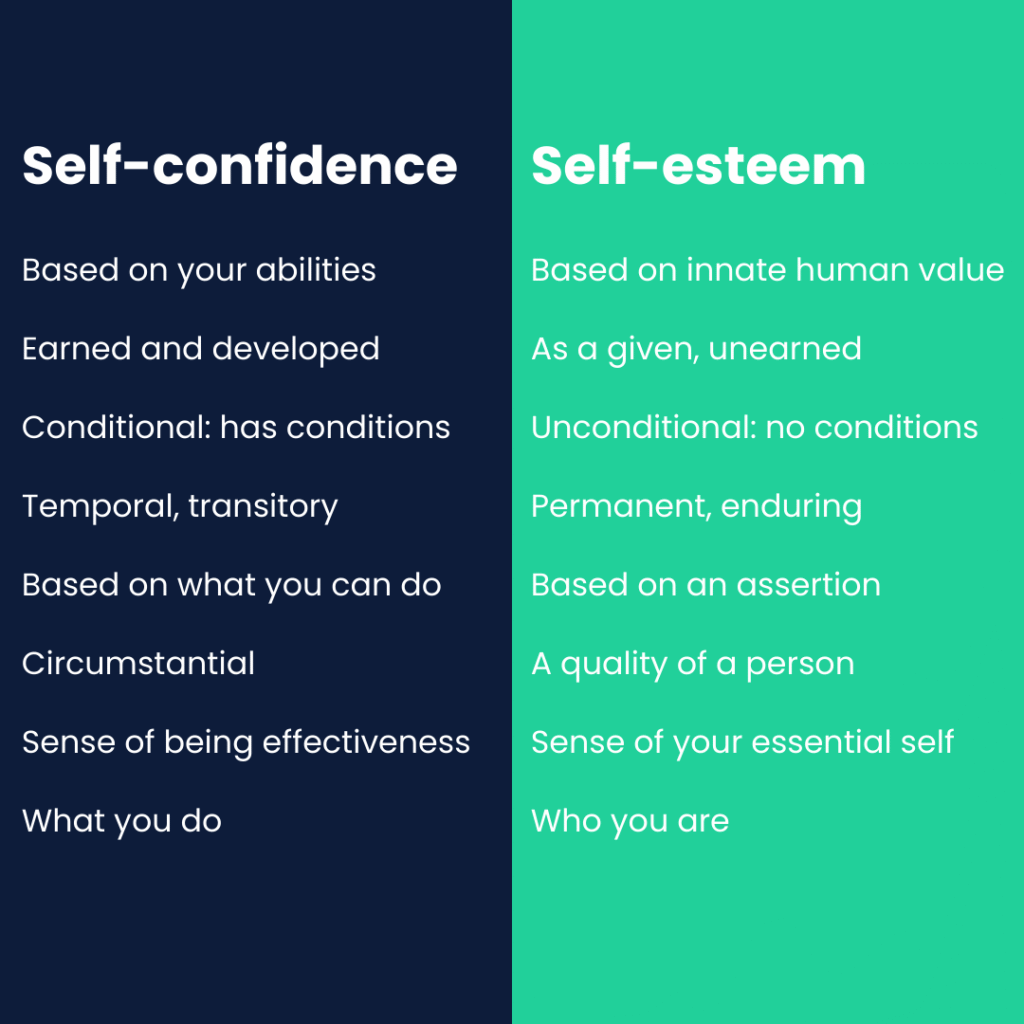
Therefore, self-worth or self-esteem represent your value system or personal philosophy. This is determined by silent assumptions and presuppositions you have about yourself that are equated with your personal worth. Each person has a personal narrative, a silent conversation hiding behind reactive emotions that keep behavioural patterns in place.
So, if self-confidence is based on what you do and derived from being competent then improving it requires you to improve your competence in a specific field. And your confidence will follow. But if self-esteem is based on who you are and derived from the worth and the value you attribute to yourself, how can this be determined or changed?
As I mentioned I believe some are misdiagnosing the lack of confidence with the lack of self-esteem. When misdiagnosing we fall in the trap of trying to solve adaptive problems with technical solutions (often additive changes), which hinders development. In order to grow we must accurately diagnose adaptive challenges and formulate adaptive solutions to the challenge. I.e. You need to adapt in some way (often deductive changes). In this way some try to fix low self-esteem (an adaptive problem) through external validation by ‘adding’ more wealth, social status, titles, and other approval seeking behaviour (technical solutions). Believing their worth depends on being perceived in a certain way. What sometimes lie beneath the veneer of ambition and success is the fear of not being enough. The fear of failure, rejection, or vulnerability.
So what? You may be thinking. As long as you are successful…right? Yes, this is a great strategy for getting ahead in life, but it has an expiry date. Fear is an extremely powerful motivator and get you to do incredible things. However, when fear and anxiety is the primary motivator and driving force in your life, there will be consequences, and the cost of internal wear and tear will take years off your life.
Drives, ambitions, and fear-based motivations
Where do you derive your value or worth from? Is it internally determined? I.e. who you are and how you value that. Or is it externally determined? I.e. what you do and the feedback you receive. Do you look outside to be validated, accepted and acknowledged to feel worthwhile? In other words, do you have an external or internal locus of evaluation? This will be determined by your level of conscious development. That is why many highly intelligent and successful people confuse (mingle together) confidence and esteem. They look outside to determine their value. They are desperately attempting to prove their worth to the world through what they do. They have fused their competence with their worth. What they do with who they are. Their identity, value, and worth are tied to the degree they are accepted, what they achieve, and how well they perform. For without that, who are they? This stems from deep seated beliefs and assumptions that took root during formative childhood years.
Are you yourself or who you think the world wants you to be? Carl Jung referred to this as the Persona or the false self. This is the mask, illusion, or the lie we think we need to live in order to survive. This mask or persona is what you need to shed to be authentic, hence the changes are deductive in nature. From a very early age we have needs that must be met in order for us to survive. These needs start with basic survival needs of water, food, comfort, security, nurture, touch, affection, love, belonging and so forth. An infant knows that if these needs are not met, they will die. So, he/she quickly learns what behaviour will help them meet those needs. They learn what values and practices will support their survival, wellbeing and security. Understandably their focus is on safety and survival. At this stage they look to the outside for validation. Their identity, self-worth, and security are based on whether they are accepted by others. They (we) become socialized and encultured, if we don’t, we face rejection from the group and that means certain death (but only at that age). Therefore, our primal motives are fear-based, the fear of not being accepted by our tribe, which will result in death. As we grow older and don’t progress through the stages of adult development, these beliefs and fears get relegated to the unconscious, but they still drive most of our behaviour. We adjust and torque ourselves to become what is asked of us to be accepted. We are no longer aware of the fear because it is kept at bay with anxiety management systems (persona) and it settles in the unconscious. Here we operate on autopilot and we’re in service of reflexive strategies that are designed to meet our needs, manage our anxiety, and keep us safe. Our anxiety is often dressed up as the need to please and a drive to succeed.
Fear has a cost:
This is how neurochemistry of fear/stress/anxiety and other destructive mental states affect physical health. Fear causes wear and tear that brings death closer faster. Ironic, that it is the fear of death I.e. not surviving that accelerates its very manifestation. Prolonged negative states of mind can trigger chronic inflammation and immune suppression through the release of pro-inflammatory cytokines. The way in which you manage fear/stress/anxiety will largely be determined by your childhood environment. These learned responses determine the subsequent assumptions you have about yourself and others and will influence your perspectives, how you relate to yourself and others, and your long-term health.
Most people who establish their self-worth, security, and identity externally fall into one of these three categories:
- If your nurture environment required that you to be nice, pleasant, kind, loyal, or liked in order to be accepted and validated, then today you will believe that you need to be compliant to the expectations of others and that you need their approval to be ok. You may believe your role is to serve the needs of others. Your self-worth and security will be based on how well you satisfy the expectations of others. You will be mostly people oriented and talk and behave in ways that please others at a significant cost to yourself, your growth, your health, your effectiveness and your authenticity. Deep down you may be motivated by the fear of rejection. If you fall in this group, you may have compromised immune function and an increased chance of developing cancer or autoimmune disease.
- If your nurture environment required that you win, get results, be perfect, or achieve high standards in order to be accepted, then today you will believe that you are the results that you achieve. That if you do not get results, then you are not ok. Your personal worth will hinge on the tasks you accomplish. You will be extremely task oriented and will likely use high control tactics to achieve results at whatever the cost. This could include being overly ambitious, autocratic, insensitive, and driven and will likely come at a cost to your ability to trust, delegate, and collaborate. High levels of adrenaline and cortisol are associated with this mindset, which may lead to an increase in hypertension, cholesterol and diabetes that will predispose you to atherosclerosis, strokes and heart disease. Deep down you may be motivated by the fear of failure.
- If your nurture environment required that you protect, detach, or distance yourself from an emotionally or physically volatile environment in order to survive, then today you will believe that you are safe when you operate mostly from your “head”. You will be ok when you are rational, intellectual and brilliant. Your self-worth and security depend on you being perceived as smart, knowledgeable, self-sufficient, independent, and intellectually superior. You may come across as distant, cold, overly analytical, critical, or arrogant. This hyper-independent mindset may come at a high cost to you in terms of limiting your influence, connection, engagement, and forming deep relationships. Deep down you may be driven by the fear of being vulnerable.
The above categories make up 85% of leaders, all of whom operate from the reactive or socialized-mind, or level of development. It’s called reactive because they look to the outside to determine your value and worth. The person operating from the reactive mind has unconscious fear-based motives and establishes their self-worth externally. It is conditional. Dependent on how they are perceived and whether they live up to the expectations they believe others have of them. Finding your worth externally through any approval seeking behaviour limits your behavioural options, professional effectiveness, growth and development. It furthermore makes you easier to manipulate. If your self-esteem hinges on how you are perceived, you will always act in ways that you believe will be welcomed and approved by others. If your identity, security and self-worth is always based on what you believe the world expects, you will remain reactive to the feedback you receive. You will only be “ok” if you live up to the self-defining assumptions supplied by your environment. In effect you will mould and adjust who you are to conform to the requirements of the day, not according to your values, intentions and vision. This naturally hinders authenticity.
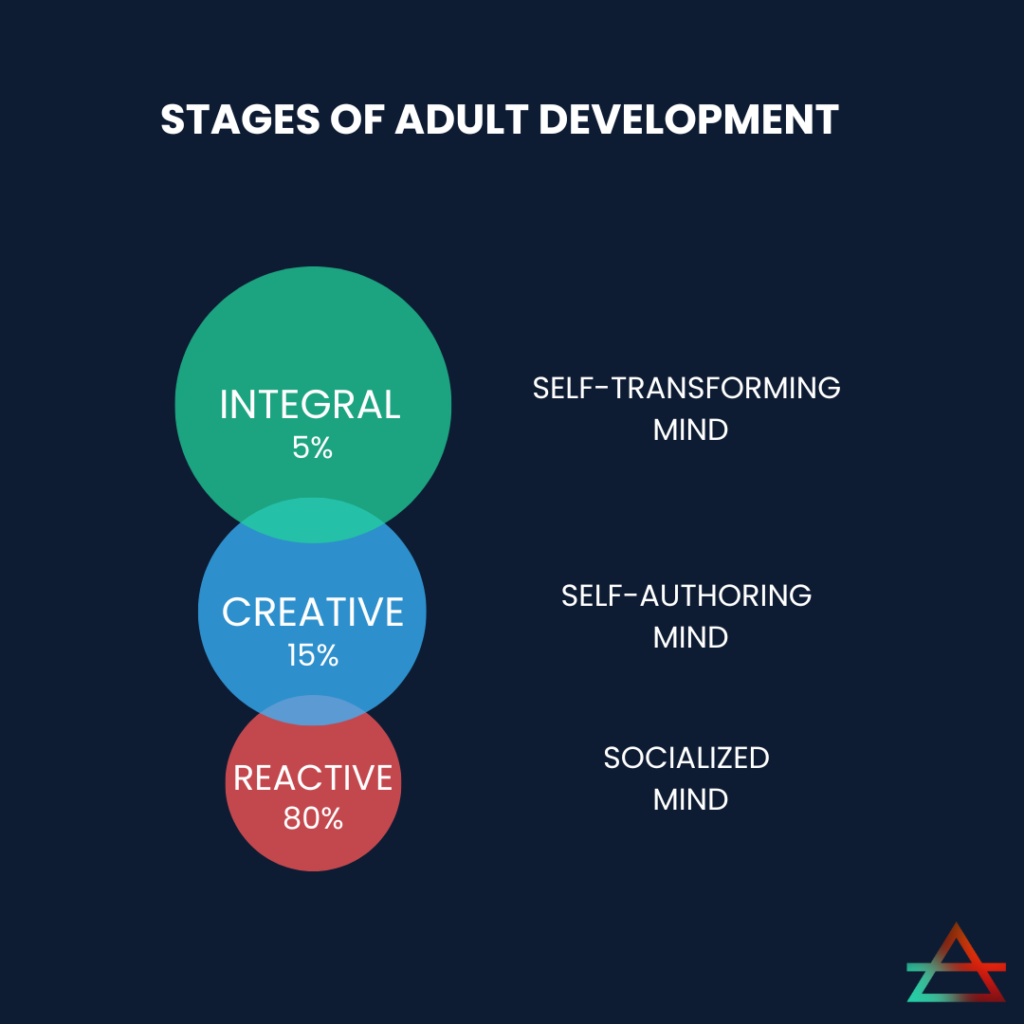
However, we can grow to the next level of conscious development where we seize to be motivated by fear. This level is referred to as the creative or self-authoring mind. Here the individual has uncovered their fear-based motivations and brought them to the light of conscious awareness. Here you identify the root cause of your mostly unconscious drivers of anxiety. Only if we see our behaviours and the motives behind them for what they are, can we choose to accept or reject the governing influence they have on our lives. In order to mature, to the next level and grow you need to become the author of your story. You become the author of your own life when you are independent of past conditioning. Then your life is no longer authored by the dictates of old beliefs based on the expectations of others.
This stage marks the shift to an internal locus of control. By unlearning conditioned assumptions, we start to see the habitual ways of thinking that we adopted while growing up that were socialized into us. These embedded habits of thought form the core of the reactive mindset. They have served us well and are now reaching operational limits. They are not complex enough for the complexity of life and leadership into which we have grown. We must identify, see and unlearn these assumptions in order to grow, transform, excel, and thrive.
As long as you try and prove your worth to the world, you will never rest from fear, and you will never be enough. It’s only when you accept in yourself that you have intrinsic worth that you will be able to find peace. An eternal peace that has nothing left to prove, nothing to chase, and nothing to hide. Here you live with intention, vision, authenticity and are directed by your internal compass rather than by the way the wind blows.
Thank you for reading
Reinhard